
Peak Seeker
Member
- Joined
- Oct 2, 2025
- Messages
- 55
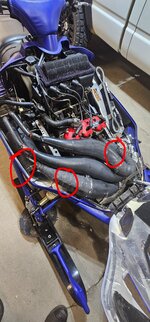
I don't have exact photos of it, but I marked up a photo of the sled to show the three general spots.Do you have pics of what melted? The SLP instructions were written at a time when the bar was apparently quite low for such a thing.
It was the clutch side pipe, near the shock mount, as well as the pipe near the mag side pipe where it rests on the heat taped area, and the silencer rubs on the side of the belly pan.
I found that if I lifted the pipe that is near the mag side shock mount that it brought everything more I to alignment, as the other two pipes rest on that lowest pipe. So I feel that a single heat shield there that lifts it will make the difference.
This is all off of memory from last winter so my recollection may not be perfect.
Attachments
Peak Seeker
Member
- Joined
- Oct 2, 2025
- Messages
- 55
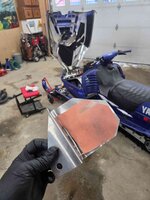
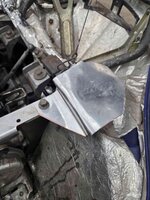
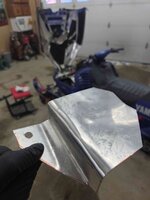
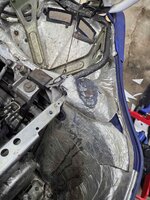
So here are a few photos, I made a shield out of aluminum with two layers of fire blanket for added insulation between the shield and the plastic.
You can see the spot by the right side upper shock mount that was getting the worst of the heat from the mag side pipe.
This seems to be enough, and was pretty quick to whip up with a metal blade on the circular saw, my vise and a dead blow.
However, even though I got the sled dialed with the factory set up, it still isn't running properly with these pipes. I'm about to drop it off with the local Yamaha guy here to just let him try to figure it out. I paid an arm and a leg for these damned pipes so I want them to work!
I followed the SLP spec sheet, I've got 147.5 mains jets, the blue/white spring, 8CR weights with steel 13.3mm weights on the inside and steel 10.3mm weights on the outside, and the secondary is clocked as suggested.
It will pull to 8600 rpm from a dig, then slowly fade down to 7000rpm as track speed is built up.
I'd love to hear what people have to say for possible solutions; and again to clarify, it would pull full rpm and >130km/hr with the stock clutching and pipe, but will hardly break 100km/hr with the SLP pipes and their clutching/jetting suggestions.
You can see the spot by the right side upper shock mount that was getting the worst of the heat from the mag side pipe.
This seems to be enough, and was pretty quick to whip up with a metal blade on the circular saw, my vise and a dead blow.
However, even though I got the sled dialed with the factory set up, it still isn't running properly with these pipes. I'm about to drop it off with the local Yamaha guy here to just let him try to figure it out. I paid an arm and a leg for these damned pipes so I want them to work!
I followed the SLP spec sheet, I've got 147.5 mains jets, the blue/white spring, 8CR weights with steel 13.3mm weights on the inside and steel 10.3mm weights on the outside, and the secondary is clocked as suggested.
It will pull to 8600 rpm from a dig, then slowly fade down to 7000rpm as track speed is built up.
I'd love to hear what people have to say for possible solutions; and again to clarify, it would pull full rpm and >130km/hr with the stock clutching and pipe, but will hardly break 100km/hr with the SLP pipes and their clutching/jetting suggestions.
Attachments

supercharged111
Member
I just pulled my pipes and had a melty spot right there as well. I think I have some stick on insulation and aluminum sheet laying around to try something there. I'm replacing the strut deals that tie the bumper to the bullhead plus the thing they bolt to so the center of the bellypan is coming out. Last year though my sled acted similar, it would initially tach out then around 70 just dump. It's going to take a balance of weights and the right helix to get it dialed in properly. Right now it's good enough to ride once I get it back together.
Peak Seeker
Member
- Joined
- Oct 2, 2025
- Messages
- 55
It seems unlikely that it should require a different helix to hit proper rpm.I just pulled my pipes and had a melty spot right there as well. I think I have some stick on insulation and aluminum sheet laying around to try something there. I'm replacing the strut deals that tie the bumper to the bullhead plus the thing they bolt to so the center of the bellypan is coming out. Last year though my sled acted similar, it would initially tach out then around 70 just dump. It's going to take a balance of weights and the right helix to get it dialed in properly. Right now it's good enough to ride once I get it back together.
To me the it would seem reasonable to assume that the SLP suggestions will get a guy within a few hundred rpm ±.
1800 rpm off would be a lot to have to adjust for.
supercharged111
Member
It seems unlikely that it should require a different helix to hit proper rpm.
To me the it would seem reasonable to assume that the SLP suggestions will get a guy within a few hundred rpm ±.
1800 rpm off would be a lot to have to adjust for.
A dual angle or progressive helix will help to bend that RPM curve in the right direction though. Mine would drop to low 8000s and stop climbing mph. 3 different sets of weight and essentially the same result. I want to try the late SRX weights.



i though that these pipe wanted more than 8600 rpm witch is stock pipe rpm for a yammy tripple. from what i remeber only aeen pipes where happy at stock rpm.
supercharged111
Member
i though that these pipe wanted more than 8600 rpm witch is stock pipe rpm for a yammy tripple. from what i remeber only aeen pipes where happy at stock rpm.
The dyno I found had them peaking at 8850 and I can say from experience it goes faster pulling 9000 than it does at 8500.
Peak Seeker
Member
- Joined
- Oct 2, 2025
- Messages
- 55
I believe SLP recommends clutching for 8800rpm.i though that these pipe wanted more than 8600 rpm witch is stock pipe rpm for a yammy tripple. from what i remeber only aeen pipes where happy at stock rpm.
Peak Seeker
Member
- Joined
- Oct 2, 2025
- Messages
- 55
I'll be interested in finding out what result you get out of that.A dual angle or progressive helix will help to bend that RPM curve in the right direction though. Mine would drop to low 8000s and stop climbing mph. 3 different sets of weight and essentially the same result. I want to try the late SRX weights.
I'm going to start by closing up my secondary a small amount, and then going through and freshening up my primary with new rollers and such.
It was suggested to me that I try the 97-99 14.5mm rollers, as my 2000 has the 16mm rollers.
supercharged111
Member
I believe SLP recommends clutching for 8800rpm.
I believe you are correct, they must be erring (albeit slightly) on the side of caution. It looks like the power falls off more slowly than it builds approaching peak.
I'll be interested in finding out what result you get out of that.
I'm going to start by closing up my secondary a small amount, and then going through and freshening up my primary with new rollers and such.
It was suggested to me that I try the 97-99 14.5mm rollers, as my 2000 has the 16mm rollers.
I theorize that the smaller rollers would make the clutch dump the RPMs at a lower speed, but that's just how I see the clutch operating in my mind's eye. No real world experience to back that up.
Peak Seeker
Member
- Joined
- Oct 2, 2025
- Messages
- 55
I'll be interested in finding out what result you get out of that.A dual angle or progressive helix will help to bend that RPM curve in the right direction though. Mine would drop to low 8000s and stop climbing mph. 3 different sets of weight and essentially the same result. I want to try the late SRX weights.
I'm going to start by closing up my secondary a small amount, and then going through and freshening up my primary with new rollers and such.
It was suggested to me that I try the 97-99 14.5mm rollers, as my 2000 has the 16mm rollers.
I believe you are correct, they must be erring (albeit slightly) on the side of caution. It looks like the power falls off more slowly than it builds approaching peak.
I theorize that the smaller rollers would make the clutch dump the RPMs at a lower speed, but that's just how I see the clutch operating in my mind's eye. No real world experience to back that up.
Peak Seeker
Member
- Joined
- Oct 2, 2025
- Messages
- 55
Now that I put some though into it, smaller rollers may do that yes. Also considering SLP suggest no tip rivet on the weights for the older 700's with the smaller rollers that adds some credit to what you're saying. Also, I found in the tuning chart on here that a guy with an older SX seems to claim the same thing.I believe you are correct, they must be erring (albeit slightly) on the side of caution. It looks like the power falls off more slowly than it builds approaching peak.
I theorize that the smaller rollers would make the clutch dump the RPMs at a lower speed, but that's just how I see the clutch operating in my mind's eye. No real world experience to back that up.
Here are his clutching specs with the SLP pipes found here: https://totallyamaha.com/snowmobiles/AAATuning Chart/Tuning_Chart.htm
97 SX700 8CA-00 0 0 w-s-w 4200 9000 14.5 mm rollers seem to take away mid & top speed.Gas milage also suffers stock 51/43 Green 70 this setup is run with slp triple pipes- 0....2000 ft. Trail - Aggressive yammylynport@shianet.org
I'm going to order a 51/43 (RX1) helix and start there. I don't want to buy another set of primary weights, they're so damned expensive haha.
supercharged111
Member
I'm running the RX1 helix now, it does a good job to suppress the flare of RPM down low but holds it down a little too much in the mid range. Up top though it comes back around to 8999 RPM and the sled will rock and roll. I forget if I currently have the 8DN-10 weights in there or the 8EK, no rivets in anything. Stock primary spring, I forget if I put the softer secondary spring in or not. The weird thing is I have to ride the thing for a few minutes before the RPMs settle in where they're going to stay. Often that first WOT will yield a higher RPM, gotta wonder if operating temps are a factor here. I want to get a temp gauge installed on this thing.
Peak Seeker
Member
- Joined
- Oct 2, 2025
- Messages
- 55
Have you tried messing with different secondary spring pre loads with that helix to see if you can dial it in a bit?
I bought the 8CR weights and B-W-B or W-B-W spring whichever it is that SLP suggested as well as the 13.3 and 10.3 steel rivets.
If I were to start over I'd likely just buy a set of adjustable weights, I've bought enough rivets and drilled them out and reinstalled enough times that it's becoming a PITA
I bought the 8CR weights and B-W-B or W-B-W spring whichever it is that SLP suggested as well as the 13.3 and 10.3 steel rivets.
If I were to start over I'd likely just buy a set of adjustable weights, I've bought enough rivets and drilled them out and reinstalled enough times that it's becoming a PITA
supercharged111
Member
Have you tried messing with different secondary spring pre loads with that helix to see if you can dial it in a bit?
I bought the 8CR weights and B-W-B or W-B-W spring whichever it is that SLP suggested as well as the 13.3 and 10.3 steel rivets.
If I were to start over I'd likely just buy a set of adjustable weights, I've bought enough rivets and drilled them out and reinstalled enough times that it's becoming a PITA
The weights and the RX1 helix made, by far, the biggest difference. Cranking on a spring one way or another can add or subtract a couple hundred RPM, but getting that shift curve just right is the real challenge. If you have a weight that has an odd shift curve, you'll be correcting it with a multi-angle or progressive helix. The way my sled has been acting, the correct answer is a custom dual angle helix and if the switchover point between the weights dumping and the helix changing over is off, correct it either with a helix that changes over at a different point or maybe different size rollers. I've got to find whoever I called last year as they still cut helixes for these things. Or go grab that roller secondary that I know I can get and start over, but I need to be sure that I can still get parts for it too.
Peak Seeker
Member
- Joined
- Oct 2, 2025
- Messages
- 55
Good information.The weights and the RX1 helix made, by far, the biggest difference. Cranking on a spring one way or another can add or subtract a couple hundred RPM, but getting that shift curve just right is the real challenge. If you have a weight that has an odd shift curve, you'll be correcting it with a multi-angle or progressive helix. The way my sled has been acting, the correct answer is a custom dual angle helix and if the switchover point between the weights dumping and the helix changing over is off, correct it either with a helix that changes over at a different point or maybe different size rollers. I've got to find whoever I called last year as they still cut helixes for these things. Or go grab that roller secondary that I know I can get and start over, but I need to be sure that I can still get parts for it too.
I grabbed a helix off marketplace this morning, won't be here until after the holidays unfortunately; I'll see what difference it makes and report back.
supercharged111
Member
Orrr maybe I let it zing a little too hard with the RX1 helix and settle it back down up top with some tip weight? Only one way to find out.
supercharged111
Member
Here's a post from another thread, really reinforces my findings and what everyone else on here has been saying. It's great that there's a tech section with setups that are working for other people, but there are so many variables at play that you really have to do your own research and find out what works best for you. That said, I'll be completely open about what I find works for me, my sled, and my riding style.
Hi Scott, well each weight has its own profile and its strong suit or weak. For example if you look at the force generated( Yamaha force graphs found in manuals show this) by a 8bu-00 in the first bit of clutch travel vs say a 8dn-20 weight , its clear the 8bu would be more aggressive and harder/faster upshifting then the 8dn 20 is, therefore it would be just a general rule of thumb the start angle of the helix would be smaller then that of the 8dn 20 if you were trying to get the same result. The 8dn20 being more docile on the upshift from a less abrubt curve in the weight would take to a larger first angle helix to help the secondary upshift at a faster rate to compensate or maybe I should say even out the rates of upshift between the 2 clutchs. After all, its all about upshifting quickly at a linear rate to make the sled go faster putting it in a higher gear ratio in the cvt. you asked about the finish as well, with some of the weights they don't have a lot of tip weight, so many times you can still get good belt grab by shallowing out the finish angle of the helix to keep pulling up top. By shallowing out the angle you automaticly apply more pressure to the belt, smaller angles apply more pressure. Along with more pressure you can back off on sec. spring tension, another thing that will give you more mph. since the helix is shallower you require less spring tension to keep ahold of the belt.
Each weight has different pro's and cons. The hard upshifting weights like the 8bu00 and the 89a10 don't backshift really well because of that first trait, where as the 8dn20 and 8bu10 type profiles will to a much better degree. Today we have the technology of multi angle helixs and roller secondarys and you can tune quite a bit of backshift even into a 8bu00 or 89a10 and possibly be pleased with the performance, it comes down to your personal choice and what your doing with sled to render your own decision as to how to set it up. I just merely put up a dyno run to show some weights simply outperform others and we are talking hp to the track.With sleds at a 50% loss every hp you gain back is a lot of sled lengths. no way would I leave 7hp to the track off the table if all I had to use was stock oem Yamaha weights.
the aftermarket weights literally stomped these weights in their best configuration, gaining as much as 12hp to the track, that's a ton of power to leave sitting at home on raceday!
Peak Seeker
Member
- Joined
- Oct 2, 2025
- Messages
- 55
Alright that helix finally showed up.
Here's the current clutching set up from this evenings test rip:
BWB Main Spring
8CR weights - Rivets:13.3 outer 10.3 inner
RX1 Helix, green spring, 1&6 preload
Honestly not quite the difference I was hoping for.
-Clutch engagement is 4500-4750rpm.
-Gained 200 RPM when WOT, RPM peaks at just over 8000rpm, then down to 7500 then 7200 as speed increases.
-Holding her wide open gets to 110km/hr and 7200rpm.
I have a new YGY spring which is 5kg less preload but higher spring rate which ends up with 123kg vs 111kg total force. And I have the factory weights.
I'll try the factory weights with the original rivets to see if it pulls proper RPM. Then I may move on to trying the 8CR weights with less or no rivets.
Here's the current clutching set up from this evenings test rip:
BWB Main Spring
8CR weights - Rivets:13.3 outer 10.3 inner
RX1 Helix, green spring, 1&6 preload
Honestly not quite the difference I was hoping for.
-Clutch engagement is 4500-4750rpm.
-Gained 200 RPM when WOT, RPM peaks at just over 8000rpm, then down to 7500 then 7200 as speed increases.
-Holding her wide open gets to 110km/hr and 7200rpm.
I have a new YGY spring which is 5kg less preload but higher spring rate which ends up with 123kg vs 111kg total force. And I have the factory weights.
I'll try the factory weights with the original rivets to see if it pulls proper RPM. Then I may move on to trying the 8CR weights with less or no rivets.
supercharged111
Member
If you can get past 110 commie units of speed, that R1 helix should let it start to wind back out. But you're way too far off. If you want to screw more with the 8CR weights I'd say it's time to drill some weights out. Shame on me, been distracted and not focused on getting the sled back together. I need to replace the steel mount for the front steel things that extend to the bumper, I have everything off of a parts sled just need to get mine the rest of the way apart to get the not smashed parts back on. Way back when I bought my sled it had been wrecked and repaired minus some superficial details. It was low miles, young, and otherwise a smoking deal so I bought it. Belly pan to hood fitment has been driving me nuts so I decided to fix that and it's a bit of a rabbit hole. Going to move it to a heated garage closer to me to get it back together. Then get to contributing clutching data back into this thread. We have piles of snow but the last week and a half I've been cleaning it up non stop.